

Página inicial / Notícias / Notícias da indústria / Leveling Agent Added — Why Is There Still Orange Peel After Baking
Notícias da indústria

In automotive topcoats, industrial baking enamels, and all bake-cure coating systems, a particularly frustrating failure occurs: the leveling agent has been added, the wet film looks good after spraying — yet after baking, the cured surface shows orange peel, waviness, or texture.
The root cause is almost never a failed leveling agent. It is a mismatch between the film's flow window and its cure window — and it requires a multi-variable analysis to solve. Understanding this distinction is essential for anyone formulating bake-cure topcoat systems.
A leveling agent improves surface tension uniformity during open time. It cannot extend a too-short flow window, fix poor atomization, or compensate for excessive film thickness variation.
If crosslinking begins too quickly — due to oven temperature profile, catalyst loading, or stoichiometry — the film gels before leveling is complete. Surface texture becomes permanently locked in.
As baking temperature rises, solvents evaporate and viscosity changes rapidly. If the low-viscosity window is too narrow, the film cannot take advantage of it for leveling — even with a leveling agent present.
Non-uniform application creates areas of different wet film thickness. During baking, thicker and thinner areas flow differently. This variation locks into the surface as orange peel — more uniform application is a prerequisite for effective leveling.
Droplet size and distribution from spray atomization determine the initial surface topography. Coarse atomization creates large topographic variation that the coating may not be able to fully self-level before gelation.
Oven temperature profile — ramp rate, peak temperature, time at peak — directly determines how long the film has to flow before crosslinking. Steep ramp rates reduce flow time. Bake curve optimization is often the most effective variable to adjust.
Record actual panel temperature vs. time through the oven. Identify the true duration of the low-viscosity flow window and whether it is long enough for the cure chemistry used.
Use a wet film gauge across the panel to identify thickness variation from application. Reduce variation before adjusting formulation.
Check air pressure, fluid viscosity, tip size, and gun-to-substrate distance. Improving atomization reduces the initial surface topography the coating must level out.
Ensure the solvent blend includes a proportion of slower-evaporating solvents to extend the effective flow window during the early baking phase.
Verify the selected leveling agent is thermally stable and retains activity during the baking flow window — not all leveling agents are formulated for high-temperature cure environments.
Review crosslinker / catalyst stoichiometry and cure rate. If cure begins before leveling is complete, reducing catalyst slightly or adjusting stoichiometry may open the flow window sufficiently.
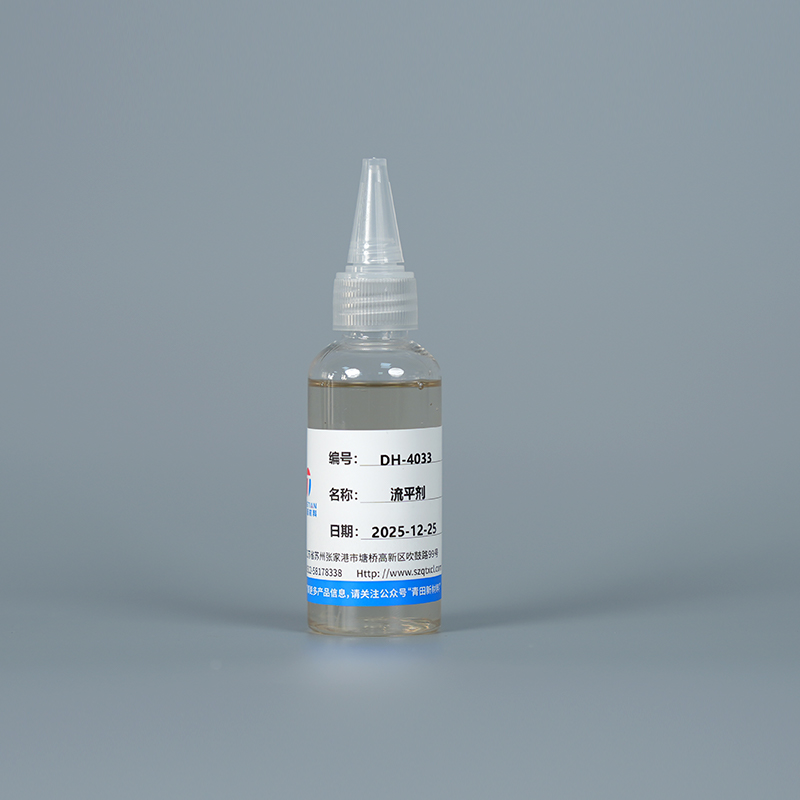
Not all leveling agents are designed for baking environments. For bake-cure topcoats and industrial enamels, the leveling agent must remain active and surface-mobile during the baking flow window — typically 120°C to 160°C — and must not volatilize, degrade, or lose surface activity before leveling is complete. Suzhou Qingtian New Materials supplies leveling agents specifically tested and selected for performance in bake-cure coating systems.
Post-bake orange peel with a leveling agent present is fundamentally a flow-window problem: the film cannot level completely before the cure reaction locks in the surface texture. Contributing factors include insufficient flow time, viscosity evolution during baking, non-uniform film thickness, atomization quality, and baking curve profile. Solving it requires multi-variable analysis — not just changing the leveling agent. Suzhou Qingtian New Materials provides leveling agents and technical consultation for solvent-based and waterborne bake-cure systems.
Our technical team provides leveling agent selection guidance and bake curve analysis support.
 Fabricantes de aditivos para tinta/revestimento no atacado
Fornecedores de soluções químicas industriais personalizadas
Fabricantes de aditivos para tinta/revestimento no atacado
Fornecedores de soluções químicas industriais personalizadas